
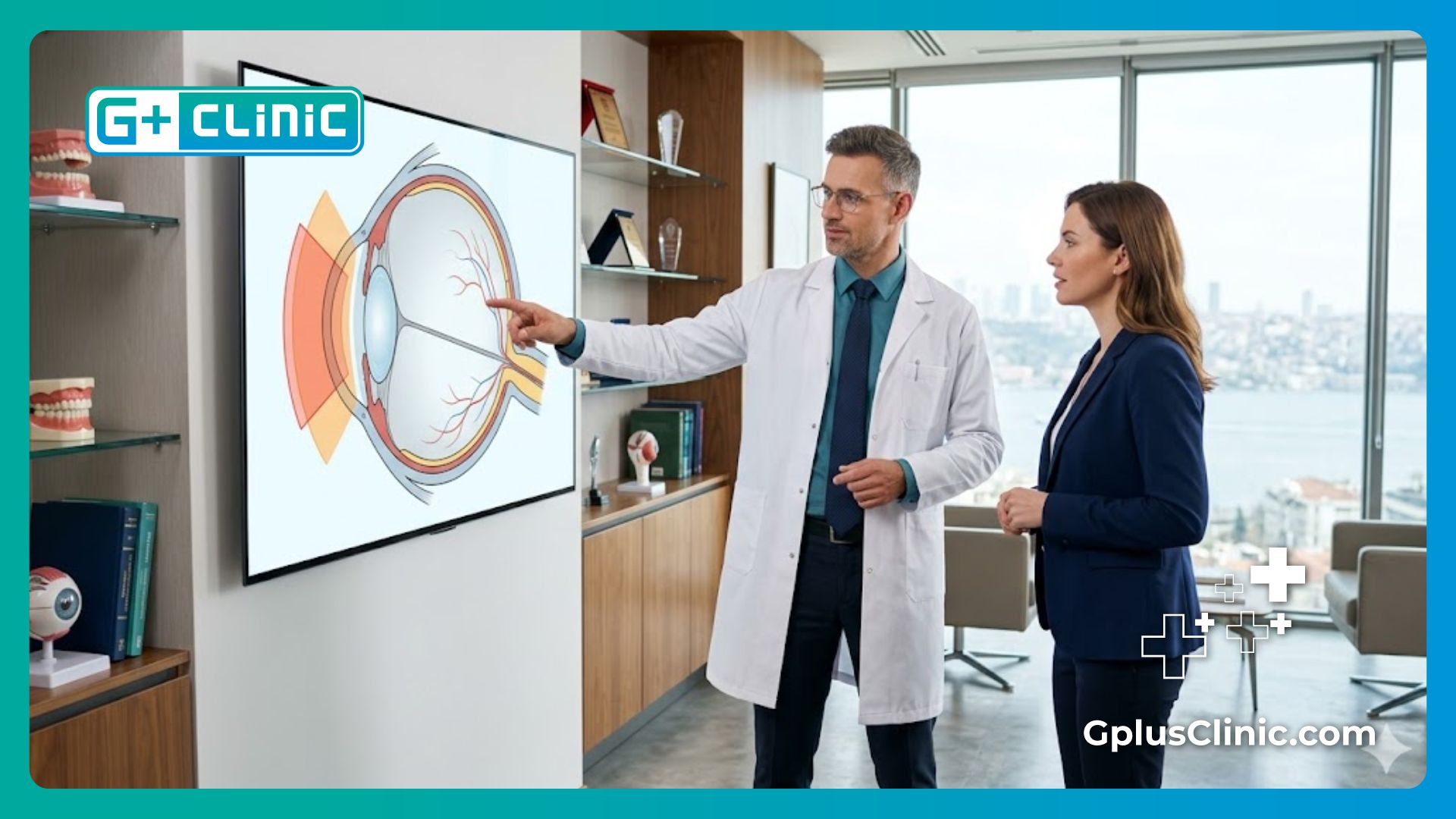
Safety is the priority when considering Risks of laser eye surgery in Turkey (Risks of laser eye surgery in Turkey). Consequently, trusting a globally recognized and fully accredited facility like G+ Clinic ensures that medical protocols surpass international standards. Furthermore, addressing the Risks of laser eye surgery in Turkey proactively empowers prospective patients to achieve flawless vision with total peace of mind.
Understanding Potential Risks of laser eye surgery in Turkey
Complications may include temporary dry eyes, night glare, and minor light sensitivity. However, strict preoperative evaluations and advanced technologies utilized by JCI-accredited facilities significantly minimize these occurrences. (According to Mayo Clinic, proper patient selection prevents the vast majority of postoperative complications and adverse events).
Risks of laser eye surgery in Turkey require careful analysis and transparent communication with your dedicated surgical team. Moreover, understanding that severe complications, such as permanent vision loss, are incredibly rare helps alleviate unnecessary anxiety for international medical tourists. Therefore, selecting an expert surgeon dramatically reduces the Risks of laser eye surgery in Turkey, transforming a daunting prospect into a highly controlled, incredibly safe medical process. Additionally, comprehensive clinical consultations serve to identify individual anatomical vulnerabilities early on. Consequently, the Risks of laser eye surgery in Turkey are effectively neutralized before the patient even enters the operating room.
“Patient safety is never a compromise; it is our foundational pillar. By meticulously screening our candidates, we actively neutralize potential surgical complications before they arise. AtG+ Clinic, our commitment to optical precision guarantees that every single procedure is executed with an uncompromising dedication to visual excellence and long-term health.” – Global Medical Authority.
Defining the Risks of laser eye surgery in Turkey
The clinical definition involves the statistical probability of adverse reactions during or after corneal reshaping. These manageable issues rarely impact long-term visual acuity when strict clinical protocols are rigorously followed. (According to Cleveland Clinic, transient side effects generally subside gradually within the first few postoperative months).
Risks of laser eye surgery in Turkey encompass physiological responses to precise optical interventions using excimer devices. Consequently, modern refractive corrections focus heavily on predicting and preventing these exact scenarios through extensive corneal topographic mapping. Furthermore, managing the Risks of laser eye surgery in Turkey relies entirely on combining state-of-the-art diagnostic tools with seasoned clinical judgment. As a result, patients experience a seamless transition to clear vision without the burden of chronic discomfort. Ultimately, acknowledging the Risks of laser eye surgery in Turkey is the first vital step toward an informed and successful medical journey.

Financial Impact and Risks of laser eye surgery in Turkey
Evaluating financial investments alongside the Risks of laser eye surgery in Turkey provides a comprehensive overview for international patients seeking supreme quality and structural affordability.
| Medical Procedure & Integrated Services | Turkey (€) | Europe (€) | USA (€) |
| Comprehensive Ophthalmic Evaluation | 100€ | 300€ | 500€ |
| Advanced Femto SMILE Intervention | 2000€ | 4500€ | 6500€ |
| Traditional LASIK Vision Correction | 1500€ | 3500€ | 5000€ |
| Surface Ablation PRK Technique | 1400€ | 3200€ | 4800€ |
| Postoperative Medications and Drops | 50€ | 150€ | 300€ |
| One-Year Regular Follow-up Care | Included | 800€ | 1200€ |
| Emergency Care Intervention (Rare) | 200€ | 1000€ | 2500€ |
| Exclusive VIP Concierge Package | 2500€ | 6000€ | 9000€ |
| Corneal Topography Mapping Test | 80€ | 250€ | 400€ |
| Protective Nighttime Eye Shields | 20€ | 60€ | 100€ |
Ultimately, allocating your budget for premium medical care effectively mitigates the Risks of laser eye surgery in Turkey while guaranteeing access to elite post-operative attention.
Technologies Mitigating Risks of laser eye surgery in Turkey
Utilizing cutting-edge ophthalmic equipment directly addresses the Risks of laser eye surgery in Turkey by significantly enhancing precision during the procedure:
- Femtosecond lasers create precise corneal flaps.
- Corneal topography accurately maps eye surfaces.
- Wavefront technology customizes specific optical treatments.
- Eye-tracking systems monitor rapid microscopic movements.
- Sterile environments prevent severe bacterial infections.
- Automated microkeratomes ensure absolute surgical consistency.
- Pachymetry measures optimal corneal tissue thickness.
Consequently, these remarkable technological advancements ensure the Risks of laser eye surgery in Turkey remain at historically low levels globally.
Ideal Candidates to Avoid Risks of laser eye surgery in Turkey
The ideal candidate is over eighteen years old, maintains a stable optical prescription for one year, possesses adequate corneal thickness, and does not suffer from severe autoimmune diseases. Identifying the perfect candidate is paramount to preventing the Risks of laser eye surgery in Turkey and ensuring enduring optical stability. Moreover, strict qualification criteria exclude individuals with chronic dry eye syndrome or extremely thin corneas, thereby protecting them from potential harm. Therefore, detailed diagnostic screening dramatically minimizes the Risks of laser eye surgery in Turkey for every prospective applicant. In contrast, proceeding without proper medical clearance significantly elevates the chances of optical regression. Thus, understanding your candidacy is intrinsically linked to controlling the Risks of laser eye surgery in Turkey perfectly.
Evaluating Zones for Risks of laser eye surgery in Turkey
Thorough anatomical examinations help in controlling the Risks of laser eye surgery in Turkey by focusing on highly specific ocular regions:
- Anterior corneal surface curvature and shape.
- Posterior corneal tissue structural integrity.
- Retinal health and macular nerve function.
- Internal intraocular fluid pressure levels.
- Pupil dilation size during nighttime conditions.
- Natural tear film production and quality.
By analyzing these precise anatomical parameters, elite surgeons effectively conquer the Risks of laser eye surgery in Turkey with unprecedented accuracy.
Anesthesia Management and Risks of laser eye surgery in Turkey
Administering topical anesthetic drops prevents systemic complications and minimizes the Risks of laser eye surgery in Turkey by avoiding the dangers associated with general anesthesia. Furthermore, the entire procedure typically concludes within a rapid ten to fifteen minutes for both eyes combined. Consequently, the patient remains fully awake, highly responsive, and capable of following the surgeon’s vital instructions regarding eye fixation.
Risks of laser eye surgery in Turkey are kept incredibly low because this localized numbing technique eliminates pain without taxing the cardiovascular system. On the other hand, a shorter time spent under the laser drastically reduces tissue dehydration and subsequent inflammatory responses. Therefore, this streamlined, highly efficient anesthetic approach keeps the Risks of laser eye surgery in Turkey strictly contained.
Timeline of Risks of laser eye surgery in Turkey
Understanding the procedural flow demonstrates how medical teams systematically manage the Risks of laser eye surgery in Turkey at every single step.
| Procedural Step | Precise Action Description | Estimated Time |
| Preoperative Prep | Sterilizing the optical region thoroughly. | 15 Minutes |
| Topical Anesthesia | Applying numbing drops to the surface. | 5 Minutes |
| Eyelid Speculum | Keeping the eye safely wide open. | 2 Minutes |
| Flap Creation | Utilizing femtosecond beams for corneal access. | 3 Minutes |
| Tissue Reshaping | Delivering excimer pulses to correct vision. | 2 Minutes |
| Flap Repositioning | Smoothing the tissue back into place. | 1 Minute |
| Initial Assessment | Confirming immediate optical structural integrity. | 10 Minutes |
| Protective Care | Applying antibiotic drops and clear shields. | 5 Minutes |
| Recovery Room | Resting quietly before clinical discharge. | 30 Minutes |
Following this rigorous, minute-by-minute protocol guarantees that the Risks of laser eye surgery in Turkey are monitored continuously and addressed instantaneously.
Why G+ Clinic Minimizes Risks of laser eye surgery in Turkey
Choosing the right facility is the ultimate strategy for reducing the Risks of laser eye surgery in Turkey and ensuring unparalleled comfort:
- Strict JCI international safety accreditation protocols.
- Globally recognized and highly experienced surgeons.
- Cutting-edge excimer and femtosecond laser machines.
- Dedicated native medical translation support services.
- Comprehensive one-year postoperative clinical follow-up.
- Exclusive VIP luxury health care packages.
- Transparent pricing without hidden financial surprises.
Relying on these robust institutional pillars guarantees that the Risks of laser eye surgery in Turkey are managed with absolute clinical mastery.
Detailed Procedure Limiting Risks of laser eye surgery in Turkey
Executing a flawless sequence is mandatory to completely suppress the Risks of laser eye surgery in Turkey from consultation to discharge:
- Conducting deep diagnostic wavefront corneal scans.
- Reviewing thorough optical medical history records.
- Designing mathematically precise laser ablation profiles.
- Administering sterile topical numbing anesthetic drops.
- Securing the eyelids with specialized medical speculums.
- Creating a microscopic flap or tiny incision.
- Deploying rapid excimer laser tissue vaporization.
- Repositioning the delicate corneal flap perfectly.
- Applying potent antibiotic and anti-inflammatory drops.
- Scheduling immediate next-day postoperative evaluation appointments.
This unwavering dedication to procedural excellence ensures the Risks of laser eye surgery in Turkey are virtually eliminated.
Technique Comparison for Risks of laser eye surgery in Turkey
Analyzing different surgical methods provides clarity on how the Risks of laser eye surgery in Turkey vary based on the chosen intervention.
| Comparative Metric | Femto-LASIK Approach | SMILE Laser Technique | PRK Surface Ablation |
| Procedural Pain Level | Practically nonexistent | Entirely painless | Mild discomfort for days |
| Visual Recovery Speed | Extremely rapid (hours) | Almost instantaneous | Considerably slower (weeks) |
| Dry Eye Probability | Moderate and temporary | Exceptionally low rate | Low and highly manageable |
| Structural Integrity | Good corneal stability | Superior biomechanical strength | Excellent long-term stability |
| Flap Complications | Possible but highly rare | Impossible (no flap created) | Impossible (surface removed) |
| Tissue Invasiveness | Moderate structural alteration | Minimally invasive micro-incision | Mild surface layer disruption |
| Thin Cornea Suitability | Generally not highly recommended | Highly suitable and preferred | The absolute safest option |
| Astigmatism Efficacy | Extremely high precision | High and incredibly stable | Accurate and structurally sound |
This detailed technical contrast empowers patients to navigate the Risks of laser eye surgery in Turkey by selecting the safest personal avenue.
Recovery Timeline and Risks of laser eye surgery in Turkey
Patients typically experience immediate visual improvement within hours, while ultimate clarity and total stabilization emerge fully between three to six months. (According to WHO, strict adherence to postoperative hygiene significantly accelerates tissue healing and prevents global infection rates).
Risks of laser eye surgery in Turkey are most prevalent during the initial healing phase, making strict adherence to guidelines paramount. Consequently, G+ Clinic provides extensive postoperative instructions to navigate these crucial early days effectively. Furthermore, understanding that slight visual fluctuations are normal prevents unnecessary panic regarding the Risks of laser eye surgery in Turkey. Therefore, patience and diligent use of prescribed lubricants guarantee a triumphant recovery.

Preparation Against Risks of laser eye surgery in Turkey
Diligent preoperative habits strongly fortify the eyes against the Risks of laser eye surgery in Turkey well before the scheduled procedure:
- Ceasing contact lens usage weeks prior.
- Avoiding all ocular cosmetic makeup applications.
- Refraining from wearing perfumes or colognes.
- Securing restful sleep the night before.
- Arranging reliable transportation for clinic discharge.
- Hydrating the body to optimize tear production.
- Reviewing all provided medical consent documents.
These proactive, highly disciplined steps dramatically reduce the Risks of laser eye surgery in Turkey by optimizing the eye’s natural condition.
Pros, Cons, and Risks of laser eye surgery in Turkey
A balanced perspective requires weighing the profound life benefits against the documented Risks of laser eye surgery in Turkey transparently.
| Life-Changing Benefits | Potential Clinical Risks |
| Total elimination of prescription optical glasses | Temporary postoperative dry eye syndrome |
| Immense improvement in daily life activities | Transient nighttime halos around streetlights |
| Incredibly rapid and entirely painless procedure | Mild visual fluctuation during the first month |
| Exceptionally precise and structurally stable results | Extremely rare cases of superficial inflammation |
| Swift recovery allowing rapid return to work | Requirement to utilize artificial lubricating drops |
| Massive boost in personal confidence and aesthetics | Temporary heightened sensitivity to bright environments |
| Significant long-term financial savings on eyewear | Highly uncommon need for minor surgical enhancements |
| Advanced technology minimizing human surgical error | Strict necessity to completely avoid rubbing eyes |
Despite the documented challenges, the life-altering advantages make the Risks of laser eye surgery in Turkey highly acceptable and clinically sound.
VIP Services Easing Risks of laser eye surgery in Turkey
Luxury concierge programs are specifically designed to reduce stress and actively diminish the Risks of laser eye surgery in Turkey for traveling patients:
- Accommodations in premium five-star luxury hotels.
- Private chauffeur transfers in comfortable vehicles.
- Personalized nursing assistance available around the clock.
- Priority scheduling for immediate medical evaluations.
- Guided, stress-free tourism experiences across Istanbul.
- Direct access to senior ophthalmic surgical consultants.
- Tailored nutritional meals supporting rapid tissue healing.
By cultivating an environment of absolute tranquility, these services indirectly combat the Risks of laser eye surgery in Turkey effectively.
Common Myths Regarding Risks of laser eye surgery in Turkey
A prevalent myth suggests lasers can cause absolute blindness, which is medically false; the procedure is purely superficial and never reaches the retina. (According to ISAPS, modern cosmetic and corrective interventions boast record-breaking safety statistics when correct standards are applied).
Risks of laser eye surgery in Turkey are frequently exaggerated by outdated misinformation and widespread internet rumors. Consequently, the elite medical staff at G+ Clinic continuously educates patients to dismantle these unfounded anxieties with hard clinical data. Furthermore, understanding the true anatomical boundaries of the laser eliminates the exaggerated Risks of laser eye surgery in Turkey entirely. In reality, the technology is governed by highly sophisticated fail-safes.
Navigating Recovery from Risks of laser eye surgery in Turkey
Following a disciplined temporal map is absolutely critical for successfully bypassing the Risks of laser eye surgery in Turkey during convalescence:
- Day One: Total resting with eyes closed.
- Week One: Vision sharpens while avoiding tap water.
- Month One: Fluctuations stabilize; drop frequency decreases.
- Month Three: Dryness vanishes; corneal flap seals completely.
- Month Six: Ultimate visual perfection is permanently achieved.
- Year One: Final clinical evaluation confirms optical stability.
By strictly honoring this biological timetable, patients masterfully outmaneuver the Risks of laser eye surgery in Turkey.
Patient Stories: Conquering Risks of laser eye surgery in Turkey
Real-world narratives beautifully illustrate how expert intervention completely neutralizes the Risks of laser eye surgery in Turkey for diverse demographics.
“David (34): I was terrified of the Risks of laser eye surgery in Turkey regarding nighttime glare. However, the wavefront technology at G+ Clinic customized my treatment, and I now drive at night with absolute, crystal-clear perfection.”
“Elena (29): As an athlete, I feared the flap complications. My surgeon recommended SMILE, bypassing those specific Risks of laser eye surgery in Turkey completely. My recovery was astoundingly fast.”
“Michael (42): Having thin corneas, I thought I was disqualified. The meticulous screening identified PRK as the safest route, proving that the right clinic expertly manages all Risks of laser eye surgery in Turkey.”
“Sophia (37): The comprehensive postoperative care obliterated my anxiety about infection. Their hygiene protocols showed me that the Risks of laser eye surgery in Turkey are effortlessly controlled.”
These authentic testimonials provide immense comfort, proving that the Risks of laser eye surgery in Turkey are exceptionally manageable.
Hidden Financial Risks of laser eye surgery in Turkey
To prevent unexpected budget strain while addressing the Risks of laser eye surgery in Turkey, patients must account for supplementary travel logistics:
- International round-trip aviation tickets and baggage fees.
- High-quality, UV-blocking prescription sunglasses for protection.
- Extra artificial tears and specialized lubricating gels.
- Personal expenses for accompanying travel companions or family.
- Mandatory electronic medical visa processing fees for entry.
- Optional upgraded luxury hotel extended stay accommodations.
Proactive financial planning ensures you focus entirely on healing rather than monetary stress, indirectly reducing the Risks of laser eye surgery in Turkey.
Maintenance Preventing Risks of laser eye surgery in Turkey
Long-term visual preservation requires adopting daily habits that consistently ward off the future Risks of laser eye surgery in Turkey gracefully:
- Wearing polarized sunglasses to block harsh ultraviolet radiation.
- Applying preservative-free hydrating drops during extensive screen time.
- Avoiding aggressive eye rubbing to protect the delicate flap.
- Attending scheduled annual comprehensive ophthalmology clinical check-ups.
- Practicing the 20-20-20 rule strictly while using computers.
- Consuming diets rich in healthy Omega-3 fatty acids.
Embracing these protective lifestyle adjustments guarantees permanent visual success, keeping the Risks of laser eye surgery in Turkey permanently at bay.
Medical Alternatives and Risks of laser eye surgery in Turkey
Comparing different modalities highlights why the Risks of laser eye surgery in Turkey are often vastly preferred over highly invasive internal ocular surgeries.
| Evaluation Metric | Laser Surface Correction (LASIK/SMILE) | Implantable Collamer Lenses (ICL) |
| Core Medical Action | Reshaping the outer corneal tissue delicately | Surgically implanting an artificial micro-lens internally |
| Potential Complications | Mild dryness, slight nighttime halos | Elevated intraocular pressure, early cataracts, internal infection |
| Clinical Healing Speed | Extraordinarily rapid (hours to days) | Moderately extended (weeks to full months) |
| Treatment Reversibility | Permanent structural anatomical tissue alteration | Fully reversible (lens can be extracted) |
| Prescription Suitability | Ideal for mild to moderate myopic errors | The definitive choice for extreme high myopia |
| Surgical Invasiveness | Exclusively external superficial tissue ablation | Deep internal penetration requiring precise microscopic incisions |
| Financial Investment | Highly cost-effective and globally accessible | Considerably expensive due to custom premium lenses |
| Long-term Maintenance | Standard routine care during initial months | Lifetime monitoring of internal eye pressure and lens |
This stark clinical contrast definitively proves that the Risks of laser eye surgery in Turkey remain remarkably superficial and infinitely safer.

Global medical authorities continuously emphasize that embracing a holistic lifestyle is the ultimate safeguard against the Risks of laser eye surgery in Turkey. Furthermore, the human eye is deeply connected to overall vascular and systemic health. Consequently, maintaining robust hydration, ensuring uninterrupted sleep cycles, and managing systemic blood pressure all contribute to flawless optical healing. Ultimately, overcoming the Risks of laser eye surgery in Turkey represents a lifelong commitment to preserving your newly restored, crystal-clear vision through mindful daily practices.
Booking to Avoid Risks of laser eye surgery in Turkey
Securing a perfectly organized medical itinerary is the first crucial step in eliminating the logistical Risks of laser eye surgery in Turkey smoothly:
- Initiating direct contact with a dedicated bilingual medical consultant.
- Submitting recent ophthalmic prescription records for preliminary clinical review.
- Discussing customized surgical blueprints and advanced technological options.
- Confirming exact procedural dates and securing necessary international flights.
- Arriving safely in Istanbul to experience VIP airport reception.
- Undergoing final, highly rigorous pre-surgical topographic diagnostic evaluations.
This meticulously structured pathway guarantees that you bypass the administrative and clinical Risks of laser eye surgery in Turkey flawlessly.
Ready to Conquer the Risks of laser eye surgery in Turkey?
In conclusion, embarking on this transformative journey requires acknowledging and intelligently managing the Risks of laser eye surgery in Turkey. Furthermore, modern refractive medicine has evolved into a realm of astonishing precision and unparalleled safety. By partnering with the elite medical professionals at G+ Clinic, you are actively choosing to eradicate optical limitations securely. Therefore, if you are truly prepared to leave your glasses behind, controlling the Risks of laser eye surgery in Turkey has never been more achievable.
FAQ about Risks of laser eye surgery in Turkey
Can this procedure lead to total permanent blindness?
Absolutely not, this is entirely medically false. The laser strictly operates on the outermost layer of the cornea and never penetrates deep enough to interact with the vital retina or the optic nerve, making this fear a complete myth.
What is the actual statistical safety success rate?
Global safety and success rates proudly exceed 98% in heavily accredited facilities. The Risks of laser eye surgery in Turkey are systematically controlled through exhaustive diagnostic imaging and the deployment of the world’s most advanced, error-free femtosecond laser technologies.
Is postoperative dry eye a permanent lifelong condition?
Dry eye is a highly common but strictly temporary symptom. It generally resolves fully within three to six months through the diligent application of prescribed lubricating drops, allowing the tear ducts to entirely regenerate their natural functional capacity.
When exactly can I safely resume using digital screens?
You can cautiously return to digital devices after 48 hours. However, it is mandatory to implement the 20-20-20 rule to actively prevent severe visual fatigue, which significantly lowers the likelihood of triggering early recovery complications.
What happens if I accidentally sneeze or move my eye?
Modern machines utilize ultra-fast, multi-dimensional eye-tracking technology. If your eye shifts even a microscopic fraction of a millimeter, the laser halts instantaneously and automatically, ensuring that surgical errors are virtually impossible to occur.


