When considering facial rejuvenation abroad, understanding the Risks of Neck Lift in Turkey is the first step towards a safe and successful transformation. At G+ Clinic, we prioritize transparency and patient safety above all else, ensuring that international standards are met to minimize complications. While Turkey offers exceptional value, navigating the potential hazards requires choosing a JCI-accredited facility that treats your health as its most valuable asset.
## Understanding the Primary Risks of Neck Lift in Turkey
The main Risks of Neck Lift in Turkey include hematoma, infection, and temporary nerve injury, but these complications occur in less than 2% of cases when performed by board-certified surgeons in accredited hospitals.
To fully comprehend the Risks of Neck Lift in Turkey, patients must be aware of the specific complications that surgical teams actively prevent:
- Hematoma (Blood Collection): This is the most common risk, mitigated by using precise drains and controlling blood pressure during surgery.
- Infection: While rare, it is one of the serious Risks of Neck Lift in Turkey that we prevent through sterile JCI-standard operating environments.
- Nerve Injury: Temporary numbness or weakness in the lower lip is possible but typically resolves spontaneously within weeks as the nerves heal.
- Scarring: Poor wound healing can lead to visible scars, which is why our surgeons place incisions discreetly behind the ears.
- Anesthesia Complications: Adverse reactions are minimized by comprehensive pre-operative screening of the heart and lungs.
Consequently, selecting a high-quality clinic is the most effective way to manage the Risks of Neck Lift in Turkey and ensure a smooth recovery.
“Safety is the absolute priority when considering any surgical procedure abroad. At G+ Clinic, we do not just perform surgery; we rigorously manage the Risks of Neck Lift in Turkey through proactive medical protocols, ensuring that every patient returns home not just looking better, but feeling healthy and secure.”
— Senior Surgeon at G+ Clinic
## Financial Analysis: Cost vs. Risks of Neck Lift in Turkey
Investigating the cost is crucial, as extremely low prices often correlate with higher Risks of Neck Lift in Turkey due to compromised safety standards and lack of accreditation.
The table below illustrates how pricing tiers reflect the level of safety and the management of Risks of Neck Lift in Turkey across different regions:
| Destination | Average Cost (€) | Safety & Quality Level | Key Considerations |
| Turkey (G+ Clinic) | €2,500 – €3,500 | High (JCI Accredited) | All-inclusive VIP care, full medical insurance. |
| United Kingdom | €7,000 – €10,000 | High | Long waiting lists, high facility fees. |
| Germany | €6,500 – €8,500 | High | Strict regulations, but very expensive. |
| USA | €9,000 – €13,000 | Very High | Separate anesthesia and hospital bills. |
| Unlicensed Clinics | €1,200 – €1,600 | Low (High Risk) | Risks of Neck Lift in Turkey increase significantly here. |
| Spain | €5,500 – €7,000 | Good | Additional costs for travel and accommodation. |
| Poland | €3,000 – €4,000 | Moderate | Language barriers may complicate care. |
| Thailand | €2,800 – €3,600 | Moderate | Long travel distance increases thrombosis risk. |
Analyzing this data reveals that while G+ Clinic offers competitive pricing, we never compromise on safety, effectively balancing cost with the mitigation of Risks of Neck Lift in Turkey.
## What is Neck Lift Surgery?
A neck lift (Cervicoplasty) is a surgical procedure designed to remove excess skin and fat from the neck area, and understanding its scope is essential to managing expectations and the Risks of Neck Lift in Turkey.
(According to the Cleveland Clinic, a neck lift specifically targets the “turkey neck” and banding, often combined with a facelift for comprehensive results).
While patients often worry about the Risks of Neck Lift in Turkey, the procedure itself is a standard operation that tightens the underlying muscles (platysmaplasty) and re-drapes the skin for a sharper jawline. It is not merely about skin removal; it involves structural restoration. Understanding this medical definition helps patients realize that the Risks of Neck Lift in Turkey are manageable when the procedure is performed by experts who understand facial anatomy deeply.
## Advanced Technologies to Reduce Risks of Neck Lift in Turkey
Modern medical technology plays a pivotal role in minimizing the Risks of Neck Lift in Turkey, allowing for less invasive techniques and faster healing times.
Here are the cutting-edge technologies we use to lower the Risks of Neck Lift in Turkey and enhance results:
- Vaser Liposuction: Uses ultrasound energy to break down fat gently, preserving blood vessels and nerves.
- J-Plasma (Renuvion): tightens the skin from within using helium plasma, reducing the need for extensive skin excision.
- High-Definition Cameras: Endoscopic brow and neck lifts allow surgeons to see tissues clearly, preventing nerve damage.
- Laser Skin Resurfacing: Improves skin texture post-surgery without the need for additional invasive cuts.
- Fibrin Glue: Used to seal tissues internally, significantly reducing bruising and the risk of hematoma.
Incorporating these technologies ensures that the Risks of Neck Lift in Turkey are kept to an absolute minimum while maximizing aesthetic outcomes.
## Ideal Candidates to Avoid Risks of Neck Lift in Turkey
Selecting the right patient is the first defense against the Risks of Neck Lift in Turkey; ideal candidates must have a BMI under 30 and realistic expectations.
(According to Mayo Clinic, candidates should be non-smokers to avoid complications with wound healing and skin necrosis).
Patients with uncontrolled diabetes or high blood pressure face significantly higher Risks of Neck Lift in Turkey. Therefore, at G+ Clinic, we conduct a thorough pre-operative assessment. Good skin elasticity is also preferred to ensure the skin re-drapes smoothly over the new neck contours. By strictly filtering candidates, we ensure that those who undergo the surgery are physically capable of healing well, thereby neutralizing many potential Risks of Neck Lift in Turkey.
## Target Areas and Associated Risks of Neck Lift in Turkey
Each anatomical zone presents unique challenges, and a skilled surgeon knows exactly how to navigate these areas to prevent specific Risks of Neck Lift in Turkey.
The following target areas are treated with extreme precision to avoid Risks of Neck Lift in Turkey:
- Submental Area (Double Chin): Fat is removed carefully to avoid contour irregularities.
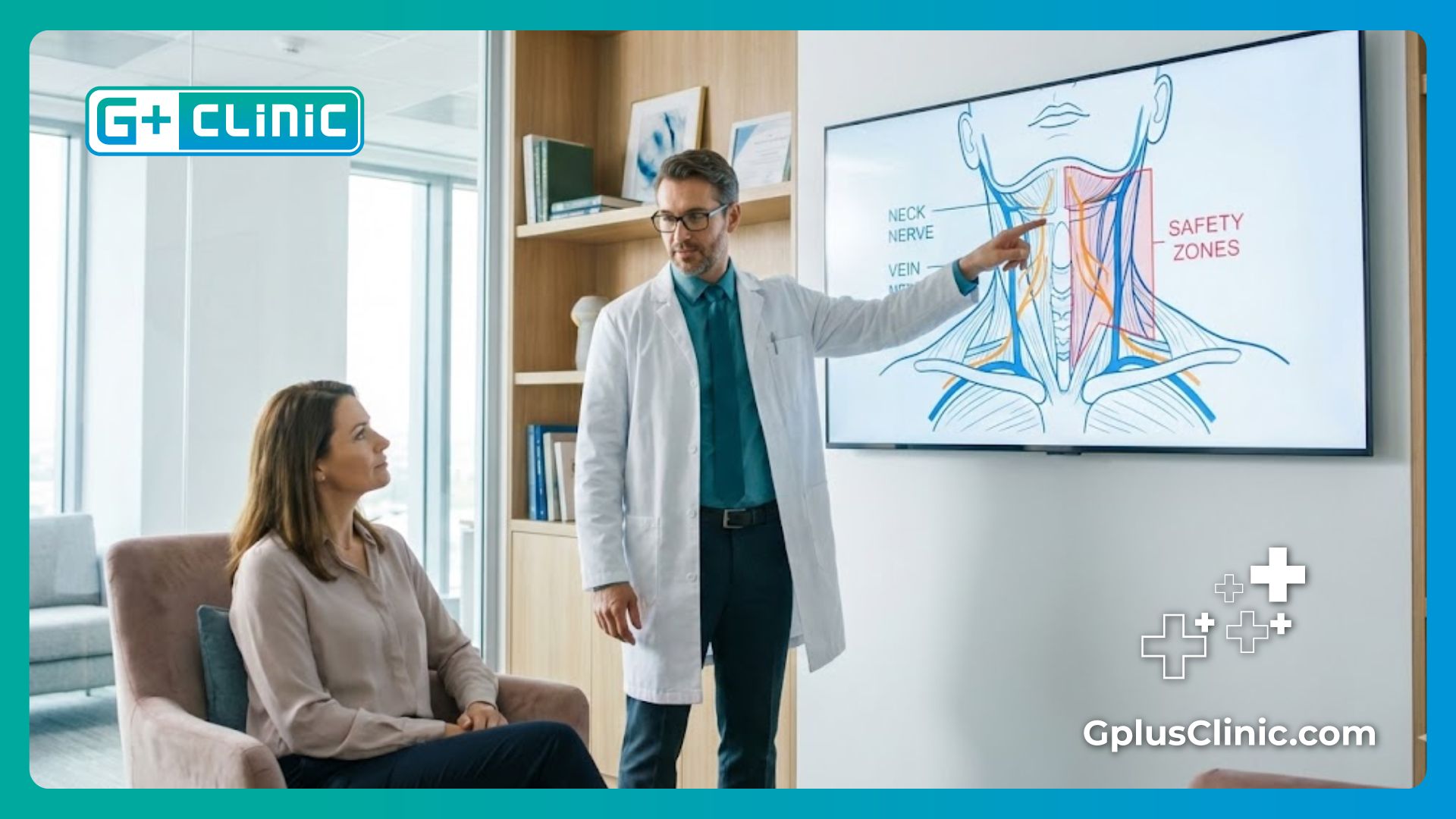
- Platysma Bands: The vertical neck muscles are tightened to eliminate the “turkey wattle” appearance.
- Cervicomental Angle: The angle between the chin and neck is sharpened for a youthful profile.
- Jawline: Definition is restored, requiring careful navigation of the marginal mandibular nerve.
- Post-Auricular Region: Skin is redraped behind the ears, where incisions must be tension-free to avoid scarring.
By focusing on these specific zones, surgeons can deliver profound results while keeping the Risks of Neck Lift in Turkey under strict control.

## Anesthesia Protocols and Duration
Anesthesia management is a critical component in mitigating the systemic Risks of Neck Lift in Turkey, with procedures typically lasting between 2 to 4 hours under general anesthesia.
At G+ Clinic, we utilize hospital-grade general anesthesia administered by board-certified anesthesiologists. This allows for total airway control and stable blood pressure, which is crucial for minimizing bleeding—one of the primary Risks of Neck Lift in Turkey. While some minor procedures can be done under local anesthesia with sedation, a full neck lift requires general anesthesia to ensure patient comfort and surgical precision. Our protocols ensure that the anesthesia-related Risks of Neck Lift in Turkey are virtually negligible.
## Steps Timeline: Managing Risks of Neck Lift in Turkey
A structured surgical timeline is essential for safety, as each step is designed to monitor and control the Risks of Neck Lift in Turkey from admission to discharge.
The table below outlines the surgical journey and how we manage Risks of Neck Lift in Turkey at every stage:
| Stage | Action & Safety Protocol | Duration |
| Preparation | Blood tests, ECG, and consultation to rule out health risks. | 1-2 Hours |
| Anesthesia | Induction of general anesthesia with continuous vital monitoring. | 30 Mins |
| Incision | Precise cuts made behind ears to minimize visible scarring. | 20 Mins |
| Correction | Tightening of muscles (Platysmaplasty) and fat removal. | 1-2 Hours |
| Closing | Multi-layer suturing to reduce tension on the skin edges. | 45 Mins |
| Recovery Room | Immediate monitoring for hematoma or reaction to anesthesia. | 1-2 Hours |
| Discharge | Transfer to private room; usually 1 night hospital stay required. | Overnight |
| Follow-up | Check-up to clean wounds and ensure no signs of infection. | Day 3 & 7 |
This timeline illustrates that managing the Risks of Neck Lift in Turkey is a continuous process that extends well beyond the operating room.
Why Choose G+ Clinic to Mitigate Risks of Neck Lift in Turkey?
Selecting a certified facility is the single most important factor in neutralizing the Risks of Neck Lift in Turkey, and G+ Clinic stands out by adhering to strict JCI (Joint Commission International) safety protocols.
Here are the specific reasons why patients trust us to handle the Risks of Neck Lift in Turkey professionally:
- JCI Accreditation: We operate under the “Gold Standard” of global healthcare safety.
- Board-Certified Surgeons: Our doctors specialize in facial anatomy to avoid nerve damage.
- Zero-Infection Policy: We utilize positive pressure operating rooms to keep air sterile.
- Comprehensive Insurance: We offer packages that cover unexpected medical corrections.
- 24/7 Nursing Care: Continuous monitoring in the hospital and hotel to detect issues early.
- Multilingual Support: Eliminating communication gaps that could lead to medical errors.
Therefore, our infrastructure is specifically designed to buffer you against the potential Risks of Neck Lift in Turkey, ensuring a seamless experience.
## Detailed Procedure Steps to Minimize Risks of Neck Lift in Turkey
Every step of the surgery is choreographed to prioritize patient safety, and understanding this workflow helps reduce anxiety regarding the Risks of Neck Lift in Turkey.
Here is the sequential procedure we follow to control Risks of Neck Lift in Turkey from start to finish:
- Final Consultation: The surgeon marks the incision sites while you are standing to ensure symmetry.
- Sterilization: The neck and face are cleaned with antiseptic solutions to prevent bacteria entry.
- Anesthesia Induction: The anesthesiologist administers sedation, monitoring heart rate continuously.
- Incision Placement: Cuts are made discreetly behind the ear or under the chin to hide scars.
- Fat Removal: Excess fat is carefully suctioned or excised without damaging blood vessels.
- Muscle Tightening: The platysma muscles are sutured together (corset platysmaplasty) for longevity.
- Skin Redraping: Skin is pulled back gently; excessive tension is avoided to prevent necrosis.
- Drain Placement: Small tubes are inserted to drain fluids and prevent hematoma formation.
- Suturing: The incisions are closed with fine sutures to minimize scarring risk.
- Bandaging: A compression garment is applied immediately to control swelling and support tissues.
Strict adherence to these steps allows our team to manage the Risks of Neck Lift in Turkey effectively at every turn.
## Technology Comparison: Impact on Risks of Neck Lift in Turkey
Different surgical technologies carry different safety profiles, and choosing the right tool is essential for managing the Risks of Neck Lift in Turkey based on your specific anatomy.
The table below compares how different methods influence the Risks of Neck Lift in Turkey:
| Technology / Method | Invasiveness | Risk Level | Primary Benefit |
| Traditional Neck Lift | High (Surgical) | Moderate | Most dramatic, long-lasting results. |
| Vaser Liposuction | Moderate | Low | Gentle fat removal, skin preservation. |
| J-Plasma (Renuvion) | Low | Very Low | Skin tightening without large incisions. |
| Laser Neck Lift | Low | Low | Improved skin texture, collagen boost. |
| Thread Lift | Minimally Invasive | Very Low | Quick recovery, but temporary results. |
| NeckTite (RF) | Moderate | Low | Radiofrequency melts fat and tightens. |
| Micro-Lipo | Low | Very Low | Precise contouring for small areas. |
| Deep Plane Lift | High | Moderate | Addresses deep structural aging. |
Analyzing this comparison helps patients and surgeons select the approach that balances desired outcomes with acceptable Risks of Neck Lift in Turkey.
## When Do Results Appear After Navigating Risks of Neck Lift in Turkey?
Initial improvements are visible immediately after dressing removal, but final results settle in 3 to 6 months once residual swelling subsides, marking the end of the primary period for Risks of Neck Lift in Turkey.
(According to ISAPS, patience is key, as post-operative edema can mask the final contour for several weeks).
Patients often mistake normal swelling for complications, raising unnecessary concerns about Risks of Neck Lift in Turkey. However, by the third week, approximately 70% of the swelling dissipates, revealing the sharper jawline. The final refinement of the scar tissue continues for up to a year. Understanding this timeline prevents panic and helps patients distinguish between normal healing and genuine Risks of Neck Lift in Turkey.
## Preparation Guidelines to Lower Risks of Neck Lift in Turkey
The success of the surgery depends heavily on pre-operative discipline, as patient non-compliance is a leading cause of preventable Risks of Neck Lift in Turkey.
Here is the mandatory preparation checklist to minimize Risks of Neck Lift in Turkey:
- Stop Smoking: Nicotine constricts blood vessels, drastically increasing the risk of skin death (necrosis).
- Avoid Blood Thinners: Stop Aspirin, Vitamin E, and herbal supplements 2 weeks prior to prevent bleeding.
- Hydration: Drink plenty of water in the days leading up to surgery to aid recovery.
- Medical Clearance: Provide all past medical records to the anesthesia team.
- Fast Before Surgery: Do not eat or drink for 8 hours before the operation to prevent aspiration.
- Plan Recovery: Arrange for a restful environment in your hotel room post-surgery.
Following these rules is your personal contribution to eliminating the controllable Risks of Neck Lift in Turkey.
## Pros and Cons: Weighing the Risks of Neck Lift in Turkey
A balanced view of the procedure is necessary for informed consent, contrasting the life-changing benefits against the inherent Risks of Neck Lift in Turkey.
The table below breaks down the advantages versus the potential Risks of Neck Lift in Turkey:
| Pros (Benefits) | Cons (Risks & Downsides) |
| Youthful Profile: Restores a sharp, defined jawline. | Hematoma: Risk of blood collection under skin. |
| Long-Lasting: Results can last 10-15 years. | Numbness: Temporary loss of sensation in ear/cheek. |
| Scars are Hidden: Incisions are not visible socially. | Recovery Time: Requires 2 weeks off work. |
| Confidence Boost: profound psychological impact. | Tightness: Feeling of constriction for a few weeks. |
| Removes Wattle: Eliminates the “Turkey Neck”. | Asymmetry: Slight differences between sides possible. |
| Cost Effective: Turkey offers 70% savings vs EU/USA. | Travel: Requires staying abroad for 7 days. |
| Dual Benefit: Removes fat and tightens muscle. | Infection: Rare, but possible without proper care. |
| Better Fit: Clothes and collars fit more comfortably. | Seroma: Fluid accumulation requiring drainage. |
While the Risks of Neck Lift in Turkey exist, they are statistically low compared to the high satisfaction rates reported by patients.
## VIP Services That Reduce Stress and Risks of Neck Lift in Turkey
Stress elevates blood pressure, which can increase bleeding risks; our VIP services are designed to keep you calm, directly helping to manage the physiologic Risks of Neck Lift in Turkey.
Our premium services aim to create a stress-free environment to mitigate Risks of Neck Lift in Turkey:
- 5-Star Accommodation: Recovery in a luxury hotel ensures comfort and hygiene.
- Private Chauffeur: VIP transfer service eliminates travel anxiety.
- Personal Assistant: A dedicated coordinator handles all logistics and scheduling.
- In-Room Nursing: Professional check-ups in your hotel room for convenience.
- Post-Op Kit: We provide all necessary medications, pillows, and garments.
By handling the logistics, we allow your body to focus entirely on healing, reducing the systemic Risks of Neck Lift in Turkey.
## Common Myths About Risks of Neck Lift in Turkey
Misinformation often exaggerates the dangers, and debunking these myths is crucial for a realistic understanding of the actual Risks of Neck Lift in Turkey.
Myth: “The surgery always leaves a ‘wind-swept’ or pulled look.”
Fact: This unnatural look is a result of outdated techniques. Modern deep-plane methods used at G+ Clinic reposition muscles naturally, avoiding the “pulled” stigma associated with Risks of Neck Lift in Turkey.
Myth: “It is too dangerous to do surgery abroad.”
Fact: Medical tourism in Turkey is highly regulated. With JCI-accredited hospitals, the safety standards often exceed those of local European clinics, meaning the Risks of Neck Lift in Turkey are no higher than in London or Berlin.

## Specific Medical Risks and Management
While we have discussed general safety, it is vital to address specific complications like nerve injury and necrosis to fully disclose the Risks of Neck Lift in Turkey.
Here is how we manage specific high-concern Risks of Neck Lift in Turkey:
- Motor Nerve Injury: The marginal mandibular nerve controls the lower lip. Injury is rare (<1%) and usually temporary (neuropraxia). Our surgeons identify and protect this nerve meticulously.
- Skin Necrosis: The death of skin tissue, usually behind the ear. This is almost exclusive to heavy smokers. We mitigate this by refusing to operate on active smokers without cessation.
- Hypertrophic Scarring: Thick, red scars. We use silicone sheets and sometimes steroid injections post-operatively to flatten any raised scars.
- Deep Venous Thrombosis (DVT): Clots in the legs due to immobility. We use compression stockings and encourage early walking to eliminate this risk.
Transparency about these specific Risks of Neck Lift in Turkey builds trust and ensures you are vigilant during recovery.
## Recovery Timeline: Navigating Risks of Neck Lift in Turkey
Recovery is a phased process where patient adherence to guidelines is the primary factor in preventing late-stage Risks of Neck Lift in Turkey.
Follow this timeline to ensure a safe journey through the Risks of Neck Lift in Turkey:
- Day 1 (In Hospital): Drains are checked; head is kept elevated to reduce swelling.
- Day 2-3 (Discharge): Drains are removed. You must rest and avoid turning your head sharply.
- Week 1 (Check-up): Stitches are removed. Bruising peaks and begins to fade.
- Week 2 (Back to Work): Most social downtime ends. Makeup can cover residual bruising.
- Week 4 (Activity): Light exercise is permitted. Numbness around the ears may persist.
- Month 3 (Normalization): Sensation returns, and the scar line begins to mature and fade.
- Month 6 (Final Result): Complete healing. The neck contour is crisp and stable.
adhering to this schedule ensures that the Risks of Neck Lift in Turkey are kept at bay until full healing is achieved.
Patient Stories: Overcoming Risks of Neck Lift in Turkey
Hearing from those who have walked this path provides the most authentic reassurance regarding the actual Risks of Neck Lift in Turkey vs the perceived fears.
Here are real experiences of patients who managed their concerns about Risks of Neck Lift in Turkey and achieved success with G+ Clinic:
- Sarah (52, UK): “I was terrified of nerve damage. The idea of a crooked smile haunted me. The surgeon at G+ Clinic mapped out my nerves with ultrasound before touching me. The precision was incredible, and my fear of Risks of Neck Lift in Turkey vanished when I woke up with a perfect smile.”
- James (48, Ireland): “As a man, I didn’t want visible scars. I thought scarring was one of the unavoidable Risks of Neck Lift in Turkey. They hid the incisions so well within my beard line and behind my ears that even my barber didn’t notice.”
- Elena (60, Germany): “My concern was anesthesia, given my age. The pre-op checks were more thorough than back home. They managed the Risks of Neck Lift in Turkey so professionally that I felt safer there than in my local hospital.”
- Fatima (39, UAE): “I worried about infection and hygiene. The clinic was spotless, like a spaceship. Seeing the JCI accreditation firsthand put all my worries about sanitary Risks of Neck Lift in Turkey to rest.”
## Hidden Costs That Affect Managing Risks of Neck Lift in Turkey
Budgeting incorrectly can lead to cutting corners, which inevitably increases the Risks of Neck Lift in Turkey, so full financial transparency is vital.
Here is a breakdown of potential extra costs to ensure you can afford the highest safety standards to avoid Risks of Neck Lift in Turkey:
- Post-Op Medications: Antibiotics and painkillers required after discharge are usually extra.
- Extra Compression Garments: You may need a second garment for hygiene while the other washes.
- Companion Expenses: Bringing a friend for support adds flight and food costs.
- Extended Stay: If healing is slow, staying an extra 2 days minimizes travel-related complications.
- Lymphatic Massage: Recommended to reduce swelling faster but often charged separately.
Being financially prepared allows you to focus on healing without stress, directly reducing the Risks of Neck Lift in Turkey related to anxiety.
## Maintenance Tips to Prevent Reoccurrence of Issues
Protecting your investment is as important as the surgery itself, as poor aftercare can mimic the failure often confused with surgical Risks of Neck Lift in Turkey.
Follow these maintenance rules to ensure longevity and avoid the return of conditions that might look like Risks of Neck Lift in Turkey:
- Sun Protection: UV rays break down collagen; use SPF 50 on your neck daily.
- Stable Weight: Gaining weight can cause fat to re-accumulate in the neck area.
- Skincare Routine: Use medical-grade neck creams to maintain skin elasticity.
- Posture Correction: Avoid “Tech Neck” (looking down at phones) to prevent skin folding.
- No Smoking: Continuing to smoke accelerates aging and compromises skin health.
Adhering to these lifestyle changes ensures that the Risks of Neck Lift in Turkey (like early relapse) are minimized.
## Comparison: Neck Lift vs. Full Facelift Risks
Understanding the scope of surgery is crucial, as a Full Facelift carries a different profile of Risks of Neck Lift in Turkey and involves more extensive tissue manipulation.
The table below contrasts the two procedures to help you assess the Risks of Neck Lift in Turkey versus a full face rejuvenation:
| Feature | Isolated Neck Lift | Full Facelift (Deep Plane) |
| Primary Focus | Jawline and Neck bands | Cheeks, Mid-face, and Neck |
| Invasiveness | Moderate | High |
| Anesthesia Time | 2 – 3 Hours | 4 – 6 Hours |
| Recovery Time | 10 – 14 Days | 3 – 4 Weeks |
| Bruising Extent | Neck and behind ears | Full face and eyes |
| Risk Level | Lower systemic risk | Higher complexity |
| Cost (Turkey) | €2,500 – €3,500 | €4,500 – €6,500 |
| Scars | Behind ears/under chin | Temples to behind ears |
Choosing the lesser invasive option often means accepting fewer Risks of Neck Lift in Turkey, provided it meets your aesthetic goals.
Healthy Lifestyle: The Ultimate Safety Net
Surgery rectifies the anatomy, but your health dictates the healing. (The World Health Organization emphasizes that optimal nutrition significantly reduces post-surgical infection rates). A diet rich in protein, Zinc, and Vitamin C is essential for repairing tissues and fighting off potential infections, acting as a biological shield against the Risks of Neck Lift in Turkey. At G+ Clinic, we provide nutritional guidance to ensure your body is as ready for the transformation as your mind is.

## How to Book Safely with G+ Clinic
Securing your surgery through a verified process is the final step in shielding yourself from the Risks of Neck Lift in Turkey associated with administrative errors.
Follow this verified booking path to ensure a seamless experience free from logistical Risks of Neck Lift in Turkey:
- Contact Us: Reach out via WhatsApp or our secure website form for a callback.
- Medical Assessment: Send photos for a preliminary surgeon evaluation.
- Risk Analysis: Discuss your medical history transparently to rule out contraindications.
- Flight Booking: Coordinate dates with our team to ensure surgeon availability.
- Arrival: Meet our VIP transfer team at the airport for safe transport.
- Pre-Op Check: Final in-person consultation and blood work before surgery.
A structured booking process is the hallmark of a professional clinic dedicated to minimizing Risks of Neck Lift in Turkey.
## Conclusion: Are You Ready for a New You?
In conclusion, while the Risks of Neck Lift in Turkey are a reality of any surgical intervention, they are overwhelmingly low when managed by the expert hands at G+ Clinic.
The journey to a defined jawline and a youthful neck does not have to be a leap of faith; it should be a calculated decision based on facts, safety protocols, and expert care. By understanding the Risks of Neck Lift in Turkey—from hematoma to anesthesia—and knowing how we prevent them, you can approach your surgery with confidence. Are you ready to look in the mirror and see the vibrant version of yourself you deserve?
## FAQ About Risks of Neck Lift in Turkey
Here we answer the most pressing questions to provide final clarity on the Risks of Neck Lift in Turkey.
What is the most common risk of neck lift surgery?
Hematoma (blood collection) is the most common complication, occurring in about 1-3% of patients. It usually happens within 24 hours of surgery due to high blood pressure. At G+ Clinic, we use drains and strict blood pressure monitoring to virtually eliminate this and other Risks of Neck Lift in Turkey.
Can a neck lift damage my voice or swallowing?
It is extremely rare. The surgery involves superficial muscles and skin, not the larynx or voice box. While you might feel tightness in the throat initially due to swelling, permanent damage to voice or swallowing functions is not among the standard Risks of Neck Lift in Turkey when performed by a specialist.
Is it safe to fly back home after surgery?
Yes, but not immediately. We recommend staying in Turkey for at least 5-7 days post-op. Flying too soon increases the risk of DVT (blood clots) and swelling due to cabin pressure. Adhering to this “No-Fly” window is a critical protocol for managing Risks of Neck Lift in Turkey.
What happens if I am unhappy with the results?
Revision rates are low (<5%), but in the rare event of asymmetry or dissatisfaction, corrective procedures can be performed after full healing (6-12 months). Discussing realistic expectations beforehand is the best way to mitigate the psychological Risks of Neck Lift in Turkey.
Does a neck lift leave visible scars?
Scars are inevitable but designed to be invisible. Incisions are placed in the natural creases behind the ears and under the chin. With proper care and scar gels, they fade to white lines that are barely detectable, addressing one of the major aesthetic Risks of Neck Lift in Turkey.