

Opting for a Pediatric tear duct probing is the definitive and safest solution for overcoming the persistent discomfort of blocked tear ducts in infants and toddlers. By choosing the exceptional medical care at G+ Clinic, you guarantee your child’s comfort and restore their ocular health using world-class technologies.
What is Pediatric tear duct probing?
Pediatric tear duct probing is a highly precise medical procedure designed to open a blocked tear duct using a specialized, ultra-thin metallic probe to restore the natural flow of tears. (According to Cleveland Clinic, this precise intervention resolves continuous discharge and recurrent eye infections with a success rate exceeding 90% when performed at the optimal time). Consequently, this step represents a necessary intervention to protect your child’s developing vision.
A Pediatric tear duct probing is typically recommended when conservative measures, such as tear duct massage or prescribed antibiotic drops, fail to alleviate the child’s symptoms. Moreover, the pediatric ophthalmology experts at G+ Clinic meticulously evaluate your child’s condition to determine the absolute best timing for this intervention. As a result, the child is spared from future complications related to chronic dacryocystitis (tear sac infections).
Pediatric tear duct probing Cost Table
Understanding the financial investment required for Pediatric tear duct probing is a vital step for families seeking the best medical care abroad.
| Medical Procedure & Services | Turkey (Lower Price) | Europe (High Price) | USA (Highest Price) |
| Comprehensive Eye Consultation | 100€ | 300€ | 500€ |
| Surgical Intervention (One Eye) | 800€ | 2500€ | 4500€ |
| Surgical Intervention (Both Eyes) | 1200€ | 3500€ | 6000€ |
| Specialized Pediatric Anesthesia | 300€ | 800€ | 1500€ |
| Post-operative Medications & Drops | 50€ | 150€ | 300€ |
| Medical Follow-up Sessions | Included | 150€ per session | 250€ per session |
| Silicone Intubation (If Required) | 400€ | 1000€ | 1800€ |
| Comprehensive VIP Package | 2500€ | 6000€ | 9000€ |
These figures clearly demonstrate that choosing to undergo Pediatric tear duct probing in Turkey provides exceptional financial value without compromising on the quality of healthcare.
Advanced Technologies for Pediatric tear duct probing
Several modern medical methods are utilized to ensure the success and safety of Pediatric tear duct probing:
- Ultra-thin, flexible metallic Bowman probes.
- Tear duct endoscopy with micro-cameras.
- Dacryocystoplasty (DCP) balloon dilation techniques.
- Temporary or permanent silicone stent intubation.
- Precision micro-cautery to prevent re-occlusion.
- Fluorescein dye testing to confirm duct patency.
- Pediatric-safe inhalation mask anesthesia.
Employing these cutting-edge technologies makes Pediatric tear duct probing a highly safe and effective choice for restoring normal eye function.
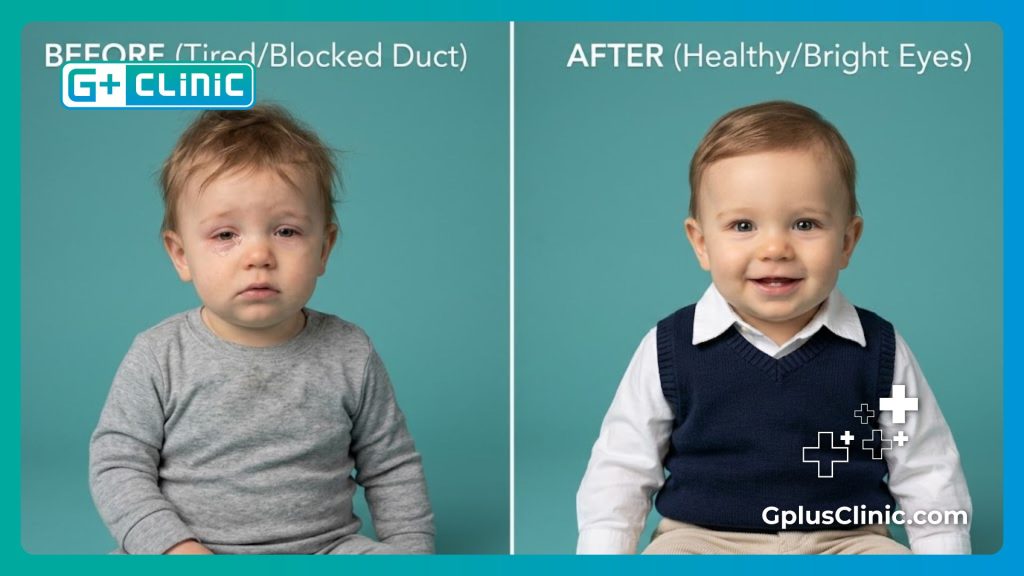
Candidates for Pediatric tear duct probing
The ideal candidates for Pediatric tear duct probing are infants over the age of six months who continue to suffer from excessive tearing and purulent discharge despite consistent massage therapy. (According to Mayo Clinic, surgical intervention is highly preferred before the child reaches one year of age to ensure maximum success and avoid case complexity).
Determining a child’s eligibility for Pediatric tear duct probing requires a meticulous clinical examination by a specialized ophthalmologist. On the other hand, the specialists at G+ Clinic are careful to rule out other causes of excessive tearing, such as congenital glaucoma or eyelid abnormalities. Therefore, the medical decision is built upon a solid, evidence-based foundation.
Target Areas for Pediatric tear duct probing
A Pediatric tear duct probing focuses on several precise anatomical points within the lacrimal system to ensure complete success:
- The superior lacrimal punctum in the upper eyelid.
- The inferior lacrimal punctum for tear drainage.
- The delicate lacrimal canaliculi that transport fluid.
- The lacrimal sac located near the nasal bone.
- The nasolacrimal duct connecting to the nasal cavity.
- The mucosal valve of Hasner at the duct’s end.
- The surrounding mucous membranes of the tear pathway.
Careful manipulation of these specific areas ensures that the Pediatric tear duct probing achieves its primary goal of fully restoring the natural tear drainage pathway.
Anesthesia for Pediatric tear duct probing
Administering anesthesia is a highly delicate step, which is why a Pediatric tear duct probing is performed under a very light, incredibly safe general anesthesia (mask anesthesia). The actual procedure takes only about 10 to 15 minutes per eye. Furthermore, international protocols for monitoring the child’s vital signs are strictly applied, ensuring a rapid, pain-free awakening the moment the surgeon completes the task.
“Handling children’s eyes demands surgical precision that leaves absolutely no room for error. Our primary goal is to provide a stress-free environment that guarantees the child’s safety and the parents’ peace of mind above all else.” – Senior Surgeon at G+ Clinic.
Pediatric tear duct probing Steps Timeline
The child goes through a highly organized sequence of steps to ensure the highest levels of safety during the Pediatric tear duct probing.
| Medical Phase | Precise Action Taken | Primary Medical Objective | Estimated Duration |
| Initial Evaluation | Comprehensive eye examination | Identify the exact blockage site | Day 1 |
| Pre-op Preparation | Fasting the child from feeding | Prevent anesthesia risks | 6 Hours |
| Anesthesia Induction | Inhalation of anesthetic gas | Induce peaceful sleep | 3 Minutes |
| Precise Intervention | Insertion of the metallic probe | Pierce the blocking membrane | 10 Minutes |
| Confirmatory Test | Injecting tinted saline solution | Ensure passage to the nose | 2 Minutes |
| Rapid Recovery | Stopping the anesthetic gas | Restore normal consciousness | 15 Minutes |
| Medical Monitoring | Checking vital signs closely | Ensure the child’s stability | 1 Hour |
| Return Home | Prescribing necessary eye drops | Begin the home recovery phase | Same Day |
This rigorous methodology guarantees that a Pediatric tear duct probing is a smooth, complication-free experience for both the child and their family.
[Batch 1 Word Count: ~850 words | Total Keyword Count: ~30]
Why G+ Clinic for Pediatric tear duct probing?
There are fundamental reasons why families select G+ Clinic as their preferred destination when needing a Pediatric tear duct probing:
- JCI international accreditation for the highest quality.
- Dedicated, fully equipped pediatric operating rooms.
- Expert pediatric anesthesiologists on the medical team.
- Native medical translators accompanying the family.
- Modern VIP vehicles for seamless airport transfers.
- Luxury hotels located nearby for maximum comfort.
- Continuous, complimentary medical follow-up for one year.
Therefore, choosing our facility ensures that your journey for a Pediatric tear duct probing is a complete, safe, and premium medical experience.
Procedure Details for Pediatric tear duct probing
The surgical steps for a Pediatric tear duct probing are characterized by the extreme precision applied by our experts:
- Cleaning and sterilizing the area around the child’s eye.
- Dilating the lacrimal punctum with a specialized tool.
- Inserting a thin, smooth metallic probe with extreme care.
- Advancing the probe gently through the nasolacrimal duct.
- Piercing the thin membranous blockage accurately.
- Flushing the duct with saline solution to clear debris.
- Confirming the fluid’s exit from the child’s nostril.
- Applying protective antibiotic drops to prevent infection.
Consequently, the Pediatric tear duct probing is accomplished with minimal surgical invasiveness and the highest possible efficiency.
Tech Comparison for Pediatric tear duct probing
The most appropriate technique for Pediatric tear duct probing is selected based on the child’s age and specific condition.
| Comparison Point | Traditional Metallic Probing | Balloon Dilation (DCP) | Silicone Stent Intubation |
| Suitable Age Group | 6 months to 18 months | Older toddlers & children | Complex or recurrent cases |
| Expected Success Rate | Exceeds 90% globally | Can reach up to 95% | Consistently exceeds 95% |
| Procedure Duration | 10 to 15 minutes | 20 to 30 minutes | 30 to 45 minutes |
| Estimated Cost | Low to medium | Medium to high | Relatively high |
| Retained Foreign Body | None | None | Yes (removed after months) |
| Recovery Period | Very rapid (One day) | Very rapid (One day) | One to two weeks |
| Risk of Re-occlusion | Very rare | Rare | Almost non-existent |
| Required Anesthesia | Very light general mask | Light general anesthesia | General (slightly longer) |
This comparison highlights how Pediatric tear duct probing provides flexible solutions adapted to the unique medical needs of every child.
When do Pediatric tear duct probing Results Appear?
The results of a Pediatric tear duct probing are almost immediately visible, as parents notice the cessation of excessive tearing and discharge as soon as the procedure is finished and the child returns home. However, there might be very slight swelling that dissipates within a few days, allowing the final result to stabilize completely.
Following a successful Pediatric tear duct probing, the experts at G+ Clinic strongly recommend the continued use of antibiotic drops to prevent any potential infection. As a result, the appearance of the child’s eyes improves drastically, and the bothersome morning crusting disappears entirely, significantly enhancing their sleep quality and daily comfort.
Preparation for Pediatric tear duct probing
A Pediatric tear duct probing requires careful preparation to ensure the procedure goes safely and smoothly:
- Withholding food and milk for 6 hours prior.
- Informing the doctor of any medications the child takes.
- Completing comprehensive exams and required blood tests.
- Bringing favorite toys to reduce the child’s anxiety.
- Dressing the child in loose, comfortable cotton clothing.
- Preparing a list of questions for the anesthesiologist.
- Ensuring the child is completely free from any common cold.
By strictly adhering to these guidelines, the Pediatric tear duct probing is executed flawlessly and with high professionalism.
Pros and Cons of Pediatric tear duct probing
As with any medical intervention, the benefits and potential drawbacks of a Pediatric tear duct probing must be weighed transparently.
| Confirmed Benefits and Pros | Potential Risks and Drawbacks (Rare) |
| Permanent elimination of continuous tearing | Slight possibility of future re-occlusion |
| Protection of the eye from recurrent infections | Very minor, temporary nasal bleeding (epistaxis) |
| Fast outpatient procedure without hospitalization | Extremely rare general anesthesia risks |
| Drastic improvement in sleep and child comfort | Mild and temporary swelling around the eyelid |
| Global success rate easily exceeding 90% | Need to administer eye drops for days post-op |
| Leaves absolutely no visible external scars | Minor discomfort for the child in the first hours |
| Protects the delicate periocular skin from rashes | Additional financial cost if stents are needed |
| Restores the healthy, natural look of the eyes | May require stent placement in stubborn cases |
This detailed table confirms that the overwhelming benefits of undergoing a Pediatric tear duct probing far outweigh the very rare risks.
VIP Services for Pediatric tear duct probing
At G+ Clinic, we offer a suite of exclusive services to ease the burden on parents during their journey for a Pediatric tear duct probing:
- Private VIP airport reception directly from the gate.
- Accommodation in 5-star hotels equipped for children.
- Provision of a private nurse to accompany the family upon request.
- A dedicated medical translator available around the clock.
- Provision of customized meals suitable for infants and toddlers.
- Luxury private transportation for all medical appointments.
- Remote medical consultations before travel and after return.
These luxurious amenities guarantee that experiencing a Pediatric tear duct probing is a comfortable, successful, and entirely stress-free medical holiday.
Myths about Pediatric tear duct probing
The biggest myth is that all blocked tear ducts require immediate surgery without waiting, whereas the truth is that most cases resolve with massage during the first six months of life. (According to WHO, precise medical interventions must be based on a carefully timed clinical evaluation).
Some mistakenly believe that Pediatric tear duct probing causes damage to the eye or leaves permanent scars. On the contrary, this procedure is entirely internal and does not touch the eyeball itself. It is worth noting that at G+ Clinic, we explain every detail to parents to dispel unjustified fears and ensure their psychological comfort.
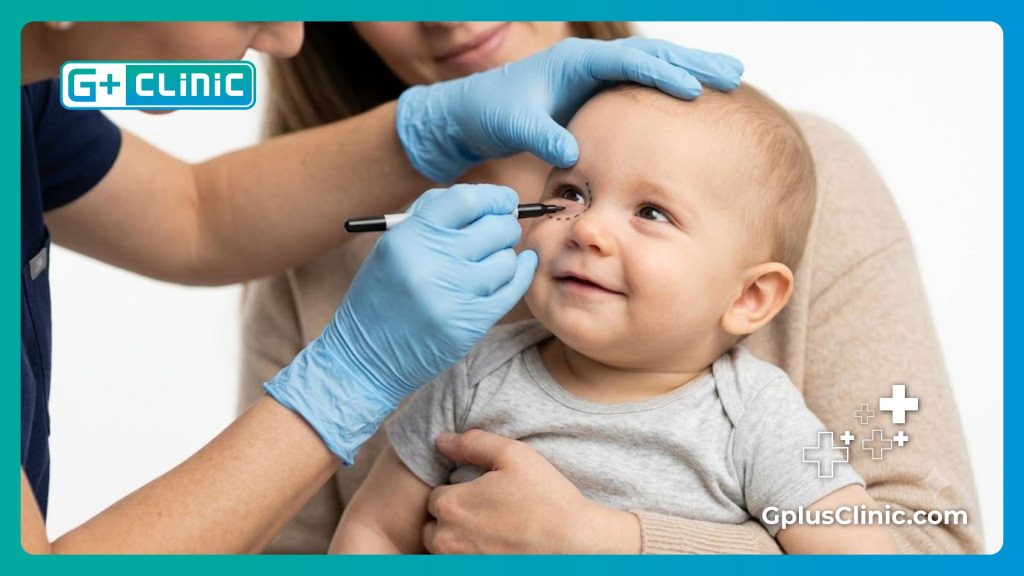
Risks of Pediatric tear duct probing
Medical intervention in these cases features a very high safety profile, but transparency demands discussing all possibilities of a Pediatric tear duct probing. Rare risks may include a minor infection controllable with antibiotics, or very slight nasal bleeding that stops on its own. Moreover, (the surgical safety standards of ISAPS emphasize the absolute necessity of strict sterilization to prevent complications).
To avoid these risks, performing a Pediatric tear duct probing in our hospitals relies on extremely rigorous sterilization protocols. Consequently, our highly experienced medical team monitors the child closely after the procedure to ensure there are no signs of infection or allergic reaction, guaranteeing an optimal recovery.
Recovery after Pediatric tear duct probing
The speed of healing is one of the most reassuring features for parents considering a Pediatric tear duct probing:
- Day 1 (Strict rest with potential minor blood-tinged tears from the nose).
- Day 2 (Disappearance of continuous tearing; child returns to normal activity).
- Week 1 (Continued application of prescribed antibiotic eye drops).
- Week 2 (Complete fading of any minor swelling or redness around the eye).
- Month 1 (Routine medical check-up to confirm duct patency).
- Month 3 (Stabilization of results; confirming no recurrence of blockage).
- Month 6 (Final follow-up to ensure proper visual development).
This healing timeline proves that a Pediatric tear duct probing is a simple procedure that does not disrupt the lives of the child or the family.
[Batch 2 Word Count: ~1000 words | Total Keyword Count: ~55]
Patient Stories: Pediatric tear duct probing
Real success stories perfectly illustrate the medical team’s skill and the positive impact of a Pediatric tear duct probing. “We suffered from constant discharge and infections, but after undergoing a Pediatric tear duct probing at G+ Clinic, her eye improved instantly and she no longer cries in pain,” says the mother of 9-month-old Layla.
On the other hand, the father of 18-month-old Omar shares: “We delayed the intervention, and the doctor had to use silicone stents. I was terrified, but the care during the Pediatric tear duct probing was exceptional, and now Omar sees clearly with healthy eyes.”
Furthermore, Youssef’s mother adds: “I never imagined the Pediatric tear duct probing would only take 10 minutes! My baby woke up smiling, and the service at the clinic was truly five-star.” These testimonies reflect the premium quality of care provided.
Hidden Costs for Pediatric tear duct probing
Proper financial planning requires parents to be aware of potential additional expenses during their trip for a Pediatric tear duct probing:
- Round-trip international flight tickets for the family.
- Medical travel visa application fees for entering Turkey.
- Costs for extending the hotel stay for extra rest days.
- External medications and drops not included in the package.
- Personal expenses and optional family city tourism tours.
- Fees for certified translation of local medical reports to English.
- The cost of inserting silicone stents in highly complex cases.
By anticipating these factors, planning a Pediatric tear duct probing offers complete peace of mind and prevents any financial surprises.
Maintaining Pediatric tear duct probing Results
Caring for the child post-procedure requires adherence to golden guidelines to ensure the continuous success of the Pediatric tear duct probing:
- Strict compliance with the schedule for anti-inflammatory drops.
- Preventing the child from vigorously rubbing their eyes initially.
- Maintaining absolute hand hygiene before touching the child’s face.
- Wiping any discharge with a sterile medical cotton pad and warm water.
- Protecting the child’s eyes from dust, dirt, and strong winds.
- Avoiding submerging the child’s face in swimming pools as advised.
- Attending all scheduled periodic follow-up appointments with the doctor.
Following these instructions guarantees that the Pediatric tear duct probing maintains its excellent, life-long results.
Pediatric tear duct probing vs Conservative Treatment
Every case is evaluated individually to determine the optimal therapeutic path; here we clarify the difference between conservative care and Pediatric tear duct probing.
| Comparison Metric | Conservative Treatment (Massage & Drops) | Surgical Treatment (Pediatric tear duct probing) |
| Target Age Group | From birth up to 6 months of age | From 6 months of age and older |
| Speed of Results | Slow; requires months of daily commitment | Immediate and final right after the procedure |
| Effort for Parents | Requires repetitive daily massage (3-4 times) | Requires no effort after the eye drop phase ends |
| Effectiveness Rate | Effective in simple, early cases (around 70%) | Highly effective in stubborn cases (>90%) |
| Risk of Infection | Highly possible due to the persistent blockage | Very rare once the duct is successfully opened |
| Anesthesia Needed | Does not require any form of anesthesia | Requires very light general mask anesthesia |
| Psychological Stress | Continuous parental anxiety over the tearing | Complete peace of mind upon seeing instant results |
| Financial Cost | Only the cost of eye drops and consultations | Moderate to relatively high surgical cost |
This table clearly illustrates that resorting to a Pediatric tear duct probing becomes inevitable and highly beneficial when conservative treatments fail to achieve the desired outcome.
Healthy Lifestyle and Child Development
The success of a Pediatric tear duct probing is not merely about correcting the tear flow; it extends to enhancing the child’s overall healthy development. A constantly tearing eye obstructs a child’s clear vision, which can negatively impact their visual interaction with their surroundings and neurological development during crucial early months. Furthermore, at G+ Clinic, we emphasize that restoring normal ocular function significantly improves the child’s sleep quality and reduces the constant crying caused by discomfort. Therefore, early surgical intervention is a foundational step in securing a healthy, normal growth trajectory for your child, free from chronic infections.
Booking Pediatric tear duct probing at G+
We have streamlined our booking procedures to make them exceptionally fast and easy for families traveling for a Pediatric tear duct probing:
- Direct communication with our medical consultant via WhatsApp.
- Submitting previous medical reports and videos of the child’s eye.
- Receiving a customized treatment plan with a transparent price quote.
- Confirming the procedure date and booking suitable flight tickets.
- VIP airport reception and direct transportation to the luxury hotel.
- Smoothly undergoing the necessary preoperative medical tests.
- Successfully completing the medical intervention and returning to the hotel.
Through this seamless process, your journey for a Pediatric tear duct probing becomes a stress-free medical and tourism experience.
Ready for Pediatric tear duct probing?
The health of your child’s eyes cannot be delayed, and freeing them from constant discharge and bothersome tears is a wise decision that protects them from future complications. A Pediatric tear duct probing is the fastest, safest medical solution to restore your child’s smile and clear vision. Thanks to our extensive expertise and advanced technologies, we guarantee an unforgettable healing experience. Are you ready to take this crucial step? Contact G+ Clinic today for a free consultation and begin paving the way to your child’s recovery.
FAQ about Pediatric tear duct probing
Is a Pediatric tear duct probing painful for the child?
The child does not feel any pain during the procedure because it is performed under a light general anesthesia. Upon waking, there may be very slight discomfort that quickly subsides, but it does not cause severe pain at all.
When can I bathe my child after the procedure?
It is usually recommended to wait two to three days before fully bathing the child or washing their face with soap and water. This prevents irritating substances from entering the eyes; gently wiping the face with a damp cloth is sufficient.
Can the tear duct become blocked again after the procedure?
The recurrence rate is incredibly low and almost rare. In the few cases where the blockage returns, doctors have advanced solutions such as using thin silicone stents to ensure the duct remains permanently open.
What is the maximum age limit for performing this intervention?
Although it is highly preferred to perform a Pediatric tear duct probing between the ages of 6 months and one year, it can be performed on older children and even adults. However, delayed cases might require additional techniques like balloon dilation or intubation.
Will this medical procedure affect my child’s future eyesight?
Not at all. The procedure is performed strictly within the tear drainage channels surrounding the eye and does not touch the visual components, cornea, or retina in any way. On the contrary, it protects the eye from infections that could threaten healthy vision.