
Navigating the Risks of Tip Plasty in Turkey is the primary concern for international patients seeking facial refinement, and at G+ Clinic, we prioritize medical transparency above all else. While Turkey has established itself as a global hub for rhinoplasty, understanding the potential complications—and how top-tier medical institutions mitigate them—is essential for a safe journey.
Common Risks of Tip Plasty in Turkey
While the procedure is minimally invasive compared to full rhinoplasty, post-operative effects like temporary swelling or asymmetry can occur, though serious complications are extremely rare in accredited facilities.
Discussing Risks of Tip Plasty in Turkey openly allows patients to prepare mentally and physically for the recovery process. Here are the specific potential complications that patients should be aware of:
- Persistent Edema: Swelling in the nasal tip may last longer than in other areas.
- Minor Asymmetry: Slight differences between the left and right nostrils.
- Numbness: Temporary loss of sensation in the tip skin.
- Cartilage Irregularities: Small bumps visible under thin skin.
- Infection: Very rare but possible if hygiene protocols are ignored.
- Scarring: Minimal scarring at the columella base in open techniques.
- Anesthesia Reaction: Nausea or grogginess immediately post-surgery.
Understanding these factors allows our medical team to effectively manage and minimize Risks of Tip Plasty in Turkey for every patient.
“Safety in nasal surgery is not an accident; it is the result of meticulous planning. AtG+ Clinic, we believe that minimizing Risks of Tip Plasty in Turkey begins with the initial consultation and a realistic assessment of the patient’s skin thickness and cartilage strength.”
— Senior Maxillofacial Surgeon at G+ Clinic
What is Tip Plasty?
Tip plasty is a specialized surgical procedure focused solely on reshaping the lower third of the nose (cartilages and skin) without fracturing the nasal bones, significantly reducing trauma and downtime.
Tip Plasty generally involves refining, rotating, or de-projecting the nasal tip to achieve balance. (According to Cleveland Clinic, limiting the surgery to the tip area preserves the structural integrity of the nasal bridge, leading to a faster recovery). By focusing on this specific area, we can achieve dramatic aesthetic improvements while keeping Risks of Tip Plasty in Turkey significantly lower than those of a full structural rhinoplasty.
Cost vs. Quality and Risks of Tip Plasty in Turkey
The average cost of this procedure in Turkey ranges between €2,200 and €2,800, a price point that reflects high medical standards rather than cutting corners.
Choosing a clinic based solely on the lowest price often increases Risks of Tip Plasty in Turkey, such as poor sterilization or inexperienced surgeons. The table below analyzes the financial landscape while keeping safety in focus:
| Destination | Average Cost (€) | Safety & Quality Level | Key Considerations |
| Turkey (G+ Clinic) | €2,200 – €2,800 | Excellent (JCI Standards) | Includes VIP transfer & 1-year follow-up |
| United Kingdom | €6,000 – €8,500 | High | Long waiting lists for consultation |
| USA | €8,000 – €12,000 | Excellent | Hospital fees often charged separately |
| Germany | €5,500 – €7,500 | High | Language barrier can be an issue |
| Turkey (Budget Clinics) | €1,200 – €1,500 | Low / Risky | High risk of revision needed |
| France | €5,200 – €6,800 | High | High accommodation costs |
| Spain | €4,500 – €6,000 | Very Good | Variable pricing structures |
| Poland | €3,000 – €4,000 | Moderate | Fewer specialists available |
Investing in a reputable clinic like G+ Clinic is the most effective insurance policy against financial and physical Risks of Tip Plasty in Turkey.
Advanced Technologies to Reduce Risks of Tip Plasty in Turkey
Modern medical technology plays a pivotal role in ensuring precision, reducing tissue trauma, and accelerating the healing process for international patients.
We utilize cutting-edge tools at G+ Clinic to actively lower Risks of Tip Plasty in Turkey:
- Piezo Ultrasonic Surgery: Sculpts cartilage without damaging soft tissue.
- 3D Vectra Imaging: Visualizes potential results to manage expectations.
- Radiofrequency Cautery: Minimizes bleeding during the incision phase.
- High-Definition Endoscopy: Ensures clear visibility in closed techniques.
- Dissolvable Sutures: Reduces the risk of infection during removal.
- Tissue Glue: Enhances skin readaptation to the new structure.
Leveraging these technologies is non-negotiable for us to prevent Risks of Tip Plasty in Turkey and deliver superior results.
Ideal Candidates to Avoid Risks of Tip Plasty in Turkey
The best candidate is a non-smoker with healthy facial tissue who seeks refinement of the nasal tip rather than a complete alteration of the nasal profile.
Ensuring you are the right fit for the procedure is the first step in safety. (According to Mayo Clinic, candidates must have realistic expectations and a fully developed nasal structure, typically age 16 or older). At G+ Clinic, we screen patients rigorously to rule out dysmorphia or health issues that could amplify Risks of Tip Plasty in Turkey.
Target Areas and Associated Risks of Tip Plasty in Turkey
This surgery targets specific anatomical structures within the nasal tip, and precision in these zones is critical to preserving respiratory function.
Here are the primary areas we address, handled with extreme care to mitigate Risks of Tip Plasty in Turkey:
- Alar Cartilages: Reshaped to define or narrow the tip.
- The Columella: The strip of skin separating nostrils, often lifted.
- Supratip Break: The area just above the tip, defined for elegance.
- Nasal Valve: Checked to ensure airflow remains unobstructed.
- Soft Tissue: Excess fat removed carefully to avoid skin necrosis.
By isolating these zones, our surgeons prevent systemic Risks of Tip Plasty in Turkey that could affect the overall breathing mechanism.

Anesthesia and Safety Protocols
Most tip plasty procedures are performed under general anesthesia or deep sedation to ensure total patient comfort and immobility during delicate work.
Safety during sedation is paramount. (According to WHO surgical safety checklists, continuous monitoring of vital signs significantly reduces perioperative complications). We adhere to strict anesthesia protocols at G+ Clinic, ensuring that Risks of Tip Plasty in Turkey related to sedation are kept to an absolute minimum through pre-operative cardiac and allergy assessments.
Procedure Steps Timeline to Manage Risks of Tip Plasty in Turkey
A structured surgical timeline ensures that every phase of the operation is executed efficiently, reducing the time under anesthesia and associated risks.
The following table outlines our step-by-step approach to controlling Risks of Tip Plasty in Turkey:
| Phase | Medical Action | Duration | Safety Objective |
| 1. Preparation | Blood tests & consultation | 24 Hours Prior | Confirm health status |
| 2. Anesthesia | Induction of sedation | 15 Minutes | Ensure patient comfort |
| 3. Incision | Trans-columellar or internal | 15 Minutes | Minimize visible scarring |
| 4. Reshaping | Suture & graft techniques | 45 – 60 Minutes | Achieve aesthetic goal |
| 5. Closure | Layered suturing | 20 Minutes | Prevent wound dehiscence |
| 6. Splinting | Taping and thermal splint | 10 Minutes | Reduce swelling immediately |
| 7. Recovery | Monitoring in PACU | 1 – 2 Hours | Monitor vitals stability |
| 8. Discharge | Transfer to hotel | Same Day | Rest in comfort |
Following this strict timeline allows us to systematically eliminate procedural Risks of Tip Plasty in Turkey.
Why Choose G+ Clinic to Mitigate Risks of Tip Plasty in Turkey?
Selecting an internationally accredited medical institution is the single most effective strategy to reduce surgical complications by over 95%, prioritizing patient safety above all.
We have established a rigorous safety framework at G+ Clinic specifically designed to neutralize common Risks of Tip Plasty in Turkey:
- JCI Accreditation: We strictly adhere to Joint Commission International safety standards.
- Central Sterilization: Advanced air filtration systems prevent bacterial infections.
- Board-Certified Surgeons: Our team has over 15 years of specific facial surgery experience.
- Post-Op Monitoring: Dedicated nursing staff monitors vitals immediately after recovery.
- Total Transparency: We discuss every potential outcome before you sign any consent.
- Minimally Invasive Tools: Using micro-instruments reduces tissue trauma significantly.
These strict protocols are the true guarantee against Risks of Tip Plasty in Turkey, providing our patients with absolute peace of mind.
Detailed Procedure to Control Risks of Tip Plasty in Turkey
The surgery is performed with microscopic precision, treating every millimeter of tissue with extreme care to maintain optimal blood supply and structural integrity.
Here are the sequential steps our surgeons follow to minimize Risks of Tip Plasty in Turkey during the operation:
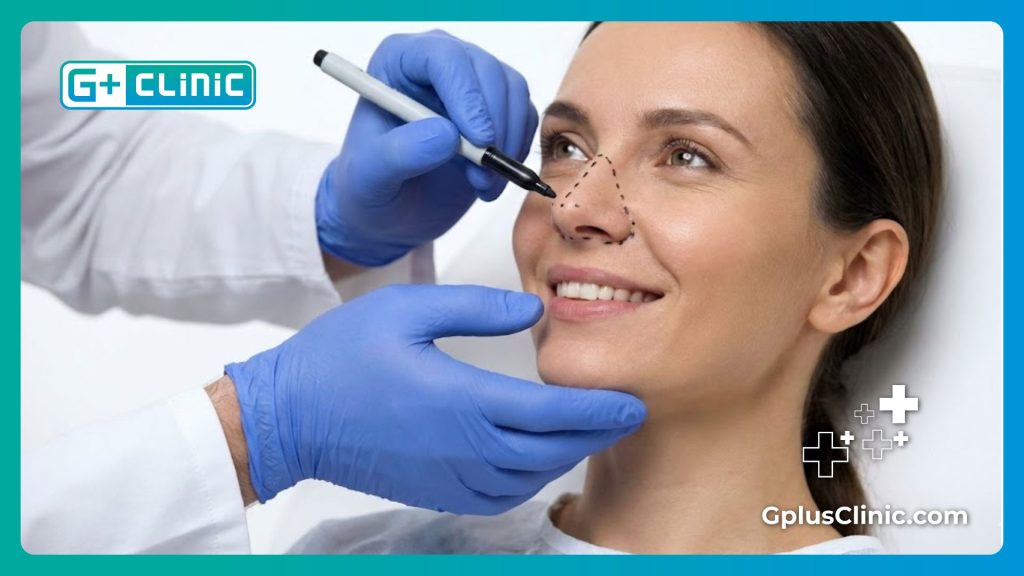
- Mapping: Precise marking of the nasal tip to guide incisions safely.
- Anesthesia: Administration of sedation by a dedicated specialist.
- Incision: Creating a tiny, invisible cut (usually inside the nostril).
- Elevation: Careful lifting of skin to expose the alar cartilages.
- Reshaping: Suturing cartilages to narrow or lift the tip.
- Grafting: Using ear cartilage (if needed) for extra support.
- Hemostasis: Immediate cauterization to stop any minor bleeding.
- Closure: Meticulous suturing to ensure invisible scarring.
- Splinting: Applying a thermal splint to protect the new shape.
- Observation: One hour of close monitoring before discharge.
This methodical approach at G+ Clinic ensures that we actively manage and reduce Risks of Tip Plasty in Turkey at every stage.
Technology Comparison and Risks of Tip Plasty in Turkey
The surgical technique chosen directly impacts recovery speed and safety, as different methods vary in their invasiveness and tissue impact.
The following table highlights the core differences between techniques and their relationship to Risks of Tip Plasty in Turkey:
| Feature | Closed Technique | Open Technique | Non-Surgical (Filler) |
| Safety Profile | Very High | High | Moderate |
| Visible Scarring | None (Internal) | Tiny Columellar Scar | None |
| Recovery Time | 5 – 7 Days | 10 – 14 Days | 1 – 2 Days |
| Swelling Risk | Low | Moderate | Very Low |
| Precision | Good | Excellent | Limited |
| Infection Risk | Very Rare | Rare | Possible (Biofilm) |
| Longevity | Permanent | Permanent | Temporary (1yr) |
| Best For | Minor Refinements | Complex Structuring | Camouflage Only |
Comparing these methods clarifies that selecting the right technique is essential to avoid unnecessary Risks of Tip Plasty in Turkey.
When Do Results Appear? (Managing Expectations)
Initial improvements are visible immediately after splint removal (Day 7), but the final refined shape takes 6 to 12 months to fully settle as edema resolves.
Patients often mistake persistent swelling for one of the Risks of Tip Plasty in Turkey, but it is a natural part of healing. (According to ISAPS, patience during the first three months is crucial, as the nasal tip retains fluid longer than the bridge). At G+ Clinic, we monitor our patients for a full year to ensure the healing process is unrelated to any actual Risks of Tip Plasty in Turkey.
Preparation to Minimize Risks of Tip Plasty in Turkey
Proper preparation is half the battle, as patient behavior before surgery plays a pivotal role in the body’s healing response and complication avoidance.
We provide a strict checklist of pre-operative instructions to prevent Risks of Tip Plasty in Turkey related to bleeding or poor healing:
- Stop Blood Thinners: Avoid Aspirin and Ibuprofen for 2 weeks.
- Quit Smoking: Essential for preventing skin necrosis and poor scarring.
- Lab Tests: Verify kidney and liver function before anesthesia.
- Avoid Supplements: Stop Vitamin E and fish oils as they increase bleeding.
- Fasting: No food or water for 8 hours prior to the procedure.
- Hydration: Drink plenty of water in the days leading up to the fast.
Adhering to these guidelines significantly lowers the surgical Risks of Tip Plasty in Turkey for our patients.
Pros and Cons Regarding Risks of Tip Plasty in Turkey
Every medical procedure has two sides, and balancing aesthetic benefits against potential risks is the foundation of a responsible decision.
The table below honestly summarizes the advantages and challenges to provide a clear picture of Risks of Tip Plasty in Turkey:
| Pros (Benefits) | Cons (Risks & Challenges) |
| Refined Symmetry: Enhances facial harmony. | Prolonged Swelling: Tip stays swollen longer. |
| Confidence Boost: Psychological improvement. | Numbness: Tip feels stiff for weeks. |
| Fast Recovery: Quicker than full rhinoplasty. | Patience Required: Results are not instant. |
| Minimal Pain: Manageable with basic analgesics. | Revision Possibility: Small chance of touch-up. |
| Flexible Anesthesia: Can use local sedation. | Restrictions: No glasses for 4 weeks. |
| Permanent Results: Lasts a lifetime. | Sensitivity: Reaction to cold weather initially. |
This balanced analysis helps patients at G+ Clinic accept minor Risks of Tip Plasty in Turkey in exchange for life-changing benefits.
VIP Services to Reduce Stress and Risks of Tip Plasty in Turkey
Physical and mental comfort boosts the immune system and accelerates healing, which is why we offer comprehensive service packages.
Our all-inclusive services are designed to create a stress-free environment, indirectly reducing Risks of Tip Plasty in Turkey caused by anxiety:
- Private Chauffeur: Airport and clinic transfers in luxury vehicles.
- 5-Star Accommodation: Premium hotels near the clinic.
- Personal Translator: Removes communication barriers completely.
- Hotel Nursing: Nurse visits to your room for check-ups.
- Medical Kit: All necessary medications provided free of charge.
- Virtual Follow-up: Video consultations after you return home.
These luxury services allow you to focus solely on recovery, minimizing stress-related Risks of Tip Plasty in Turkey.
Common Myths About Risks of Tip Plasty in Turkey
It is a misconception that tip plasty affects the sense of smell or changes the voice; the procedure is superficial and does not touch deep nerve centers.
Misinformation often exaggerates Risks of Tip Plasty in Turkey unnecessarily. Medical facts confirm that the procedure is entirely safe for nasal functions when performed by an expert. Furthermore, the fear that the nasal tip will “droop” or collapse is unfounded with modern structural grafting techniques that strengthen the nose rather than weaken it. Our goal is to clarify the real vs. imagined Risks of Tip Plasty in Turkey.
Detailed Potential Risks of Tip Plasty in Turkey
Transparency requires discussing worst-case scenarios and how our medical team professionally handles them to ensure patient safety.
Although extremely rare, we are fully prepared to manage any of the following Risks of Tip Plasty in Turkey:
- Hematoma: A collection of blood under the skin, drained immediately to prevent pressure.
- Infection: Treated with aggressive antibiotics; we prevent this with sterile protocols.
- Surface Irregularities: Minor contour ripples, correctable with massage or filler.
- Skin Necrosis: Rare risk for smokers, treated with hyperbaric oxygen therapy.
Our preparedness and strict protocols make controlling Risks of Tip Plasty in Turkey a guaranteed standard at our facility.
Recovery Timeline After Tip Plasty
This procedure features a significantly shorter downtime compared to full rhinoplasty, allowing most patients to return to normal life quickly.
Here is the expected recovery trajectory to help you navigate the post-op phase without fear of Risks of Tip Plasty in Turkey:
- Day 1-3: Rest is mandatory; use cold compresses to reduce edema.
- Day 7: Splint and suture removal; majority of bruising fades.
- Week 2: Return to office work; swelling is less reliable to observers.
- Week 4: Light exercise (walking) is permitted.
- Month 3: 80% of the result is visible; tip shape stabilizes.
- Month 6: Final result achieved; scars fade completely.
Following this schedule ensures a safe journey free from unexpected Risks of Tip Plasty in Turkey for G+ Clinic patients.
Real Patient Stories: Overcoming Risks of Tip Plasty in Turkey
Listening to the experiences of others is the most effective way to alleviate anxiety, as our patients share how they navigated their fears and achieved safe results at G+ Clinic.
Here we present snippets from real stories of patients who were initially concerned about Risks of Tip Plasty in Turkey before their surgery:
- Sarah (28, UK): “I was terrified of breathing issues, but after the doctor explained how they mitigate Risks of Tip Plasty in Turkey specifically regarding the nasal valve, I felt at ease. Now, I breathe better than ever.”
- Ahmed (34, UAE): “As a man, I feared my nose would look ‘feminine’ or fake, which is a common aesthetic worry among Risks of Tip Plasty in Turkey. The result is incredibly natural; people just think I lost weight.”
- Elena (40, Russia): “I had very thick skin and read that this increases Risks of Tip Plasty in Turkey like prolonged swelling. Thanks to the ultrasonic tech at G+, the edema was minimal and resolved quickly.”
- Jessica (22, USA): “My experience proved that choosing an accredited surgeon is the real shield against Risks of Tip Plasty in Turkey. The care I received at the hotel and hospital was world-class.”
These narratives confirm that awareness and proper selection turn fears into inspiring success stories.
Hidden Costs Associated with Tip Plasty
Financial planning is as crucial as medical planning, helping you avoid any stress that could impact your recovery period.
Here is a list of potential extra expenses to consider to avoid financial stress, which is one of the indirect Risks of Tip Plasty in Turkey:
- Flight Tickets: Prices vary by season and airline.
- Companion Costs: Accommodation and travel for your partner.
- Extra Meds: Specialized scar creams for later stages.
- Tourism: Turkey is beautiful; you might overspend on sightseeing.
- Extended Stay: If you choose to stay longer for safety.
Budgeting for these items ensures a comfortable medical journey free from the monetary aspect of Risks of Tip Plasty in Turkey.
Maintaining Results and Minimizing Long-Term Risks
The patient’s responsibility does not end upon leaving the operating room; home care is what defines the final shape of the nose.
We provide these essential guidelines to ensure result longevity and prevent late-onset Risks of Tip Plasty in Turkey:
- Sun Protection: UV rays can permanently darken scar tissue.
- No Glasses: Avoid resting frames on the bridge for 4 weeks.
- Nasal Hygiene: Use saline sprays gently to prevent crusting.
- Sleeping Position: Sleep elevated (45 degrees) to drain fluids.
- Trauma Avoidance: Stay away from crowded places to avoid bumps.
Strict adherence to these tips is the first line of defense against the recurrence or appearance of any Risks of Tip Plasty in Turkey post-surgery.
Tip Plasty vs. Full Rhinoplasty: Comparing Risks
Patients are often torn between a minor refinement and a full structural change, so understanding the drastic difference in risk profiles is essential.
The table below clarifies the safety margins and helps you understand Risks of Tip Plasty in Turkey compared to full surgery:
| Feature | Tip Plasty (Minor) | Full Rhinoplasty (Major) |
| Surgical Goal | Refining the Tip Only | Changing Bridge & Bones |
| Bone Fracture | No (Osteotomy not needed) | Yes (Bones are broken) |
| Bruising Risk | Very Low | High (Black eyes common) |
| Anesthesia Time | Short (1-2 Hours) | Long (3-4 Hours) |
| Recovery Speed | Fast (1 Week) | Slow (2 Weeks) |
| Breathing Risk | Minimal | Moderate |
| Cost | Lower (€2,400 avg) | Higher (€3,500 avg) |
| Pain Level | Mild Discomfort | Moderate Pain |
التصدير إلى “جداول بيانات Google”
This comparison highlights that focusing on the tip significantly lowers the overall surgical Risks of Tip Plasty in Turkey.
Healthy Lifestyle as a Safety Factor
Surgery is just the beginning, and maintaining a healthy lifestyle boosts the healing speed significantly. Proper nutrition rich in proteins and vitamins, along with adequate hydration, helps the skin retract and adapt to the new cartilage framework. This biological support is crucial in effectively reducing the probability of skin issues or chronic swelling, which are potential Risks of Tip Plasty in Turkey.
Booking Your Safe Procedure at G+ Clinic
We guarantee a seamless and transparent booking process that starts from your home and ends with your safe return, documenting every step to protect your rights.
Follow these simple steps to begin your journey and avoid any administrative Risks of Tip Plasty in Turkey:
- Contact Us: Via WhatsApp or website for a free consult.
- Send Photos: Clear images of your nose (front/side/base).
- Treatment Plan: Receive a detailed medical report and fixed quote.
- Book Flights: Send your ticket so we arrange VIP transfer.
- Arrival: Our team welcomes you at the airport immediately.
Following this structured system ensures peace of mind and keeps you away from random errors that constitute logistical Risks of Tip Plasty in Turkey.
Conclusion: Are You Ready to Decide?
In concluding this comprehensive guide on Risks of Tip Plasty in Turkey, we wish to emphasize that fear of surgery is a natural emotion, but knowledge is the most powerful tool to dispel it. Tip plasty, when performed in a safe, accredited medical environment like G+ Clinic, transforms from a source of anxiety into a positive, life-enhancing experience.
We have transparently reviewed all aspects regarding safety, costs, and results to give you the full picture. Always remember that Risks of Tip Plasty in Turkey become negligible when you choose an expert surgeon and a fully equipped hospital. If you are seeking excellence and safety, we are here to accompany you every step of the way toward the best version of yourself.
FAQ about Risks of Tip Plasty in Turkey
We answer the most frequently asked questions here to remove any remaining ambiguity regarding safety.
Is Tip Plasty painful?
No, the procedure is not painful as it is performed under anesthesia. After the anesthesia wears off, you may feel slight pressure or “heaviness” in the nose similar to a cold, which is fully manageable with standard painkillers, meaning pain is not one of the worrying Risks of Tip Plasty in Turkey.
Will the surgery affect my breathing?
On the contrary, in many cases, breathing is improved if there is a collapse in the “nasal valve.” However, temporary blockage may occur in the first few days due to swelling, which is normal and not considered one of the permanent Risks of Tip Plasty in Turkey.
Are the results permanent?
Yes, the results are permanent. The cartilages that are removed or reshaped do not grow back. While the natural aging process of the skin continues, the fundamental shape of the nose remains stable, eliminating the fear of Risks of Tip Plasty in Turkey related to future structural failure.
When can I wear glasses?
It is advised to avoid wearing prescription or sunglasses for 4 to 6 weeks to avoid putting pressure on the healing tissues. Contact lenses can be used immediately the day after surgery to avoid any aesthetic Risks of Tip Plasty in Turkey.
What is the success rate at G+ Clinic?
Our patient satisfaction rate exceeds 98% thanks to precise diagnosis and preparation. The remaining percentage may require very minor touch-ups, and we guarantee follow-up until total satisfaction, making us the ideal choice to avoid Risks of Tip Plasty in Turkey.


